Sant’Andrea al Quirinale



Introduction
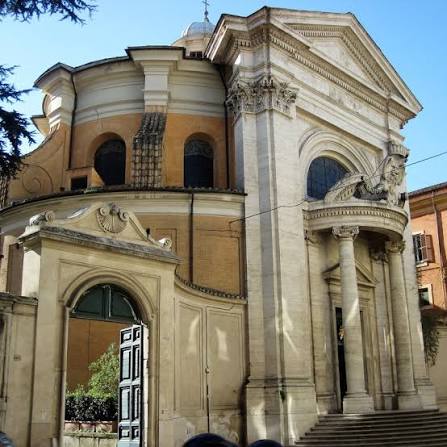
Sant’Andrea al Quirinale is one of Gian Lorenzo Bernini’s most complete architectural works: a small Jesuit church in which architecture, sculpture, painting and light are orchestrated as a single Baroque experience.
Built for the Jesuit novitiate on the Quirinal Hill, the church is organised around an elliptical interior whose short axis leads directly from the entrance toward the high altar. Bernini uses this compact geometry to create a highly controlled sequence: the visitor enters, encounters the martyrdom of Saint Andrew at the altar, and then follows the saint symbolically upward toward the dome and heaven.
Despite its modest size, Sant’Andrea has an extraordinary sense of richness and theatrical coherence. Bernini himself is traditionally said to have regarded it among his most successful works.
History
The site had a long religious history before Bernini’s church. A church known as Sant’Andrea de Caballo is documented here from the Middle Ages, while the Jesuits established themselves on the Quirinal in 1565.
A first Jesuit church was built under the direction of Giovanni Tristano and consecrated in 1568. During the following century, several attempts were made to replace it with a larger building. Ludovico Ludovisi proposed a new church, and in 1647 Francesco Borromini was involved in another project, but neither scheme was realised.
The decisive intervention came under Pope Alexander VII Chigi, who authorised the rebuilding of the church for the Jesuit novitiate and entrusted the design to Gian Lorenzo Bernini.
Construction began in 1658. The project was financed by Prince Camillo Pamphilj, whose family arms still dominate the façade. Bernini conceived the church as an integrated work in which architecture, painting and sculpture guide the viewer through the story of Saint Andrew’s martyrdom and heavenly ascent.
The present church was substantially completed during the following two decades.
What to Notice
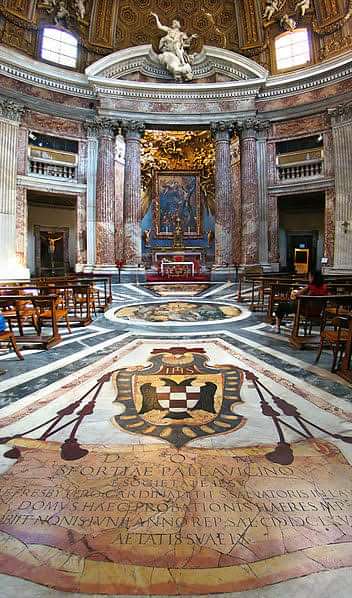
Stand just inside the entrance before walking farther in. From this point Bernini’s entire narrative becomes visible: Saint Andrew is martyred in the painting behind the altar and then appears above it in sculptural form, rising toward the luminous dome.
Notice the orientation of the oval. The widest dimension runs sideways, while the entrance and altar face each other across the shorter axis. This makes the church feel both expansive and unusually concentrated.
Look at the contrast between this church and nearby San Carlo alle Quattro Fontane. Borromini uses white surfaces, abstract geometry and restless walls; Bernini uses coloured marble, sculpture, painting and theatrical narrative.
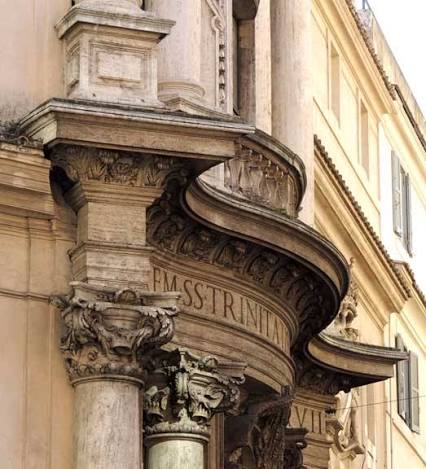
On the façade, find the Pamphilj coat of arms above the pediment. The family financed the construction.
Look for the rose garlands surrounding the façade decoration. Roses refer to martyrdom and anticipate the subject of the high altar.
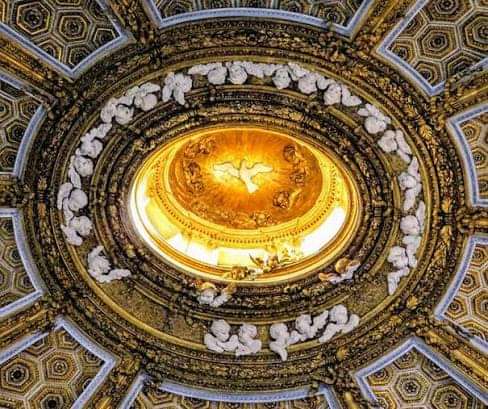
Inside the dome, watch how the windows and lantern introduce natural light into the gilded coffering and stucco figures. The illumination changes noticeably during the day.
Do not skip the side chapels. Baciccio and several other major seventeenth-century painters are represented here.
If accessible, visit the rooms associated with Saint Stanislaus Kostka in the adjoining Jesuit complex.
Today
Sant’Andrea al Quirinale remains an active Jesuit church as well as one of Rome’s major Baroque monuments.
Because the building is compact, it is possible to understand Bernini’s entire composition from the entrance: the oval plan, the high altar, the dome and the sculptural ascent of Saint Andrew are all visually connected.
The church also preserves the memory of Saint Stanislaus Kostka, the young Jesuit novice who died in the adjoining novitiate in 1568. Rooms associated with him form part of the wider historical complex.
Visitors should look beyond the central space into the side chapels and sacristy, where the artistic programme continues through painting, stucco and decorative marble.